P/E CHART
Lordstown Motors (RIDE) — P/E
Fundamental data and historical chart analysis for Lordstown Motors — powered by Stock Traders Daily research.
RIDE P/E Chart
Updated daily
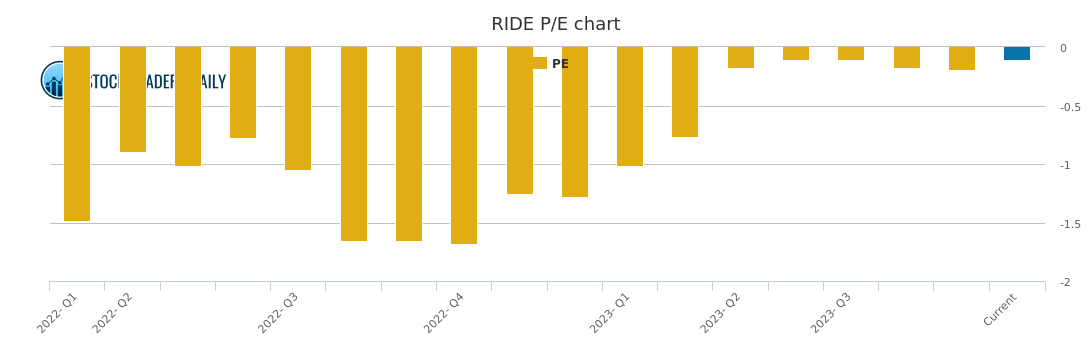
What is the P/E Ratio?
The Price to Earnings ratio (P/E) compares a company's current share price to its earnings per share. It answers the question: how much are investors willing to pay for every dollar of earnings this company produces? A P/E of 20 means investors are paying $20 for every $1 of annual earnings.
Why Does It Matter?
The P/E ratio is the most widely used valuation metric in investing. It helps investors determine whether a stock is expensive or cheap relative to its earnings. Comparing a company's current P/E to its own historical average, its industry peers, or the broader market provides important context about valuation.
How to Read the Chart
A rising P/E can mean the stock price is increasing faster than earnings — which may indicate overvaluation or high investor optimism about future growth. A falling P/E can indicate the stock is becoming cheaper relative to earnings, either because the price has fallen or earnings have grown. Very high P/E ratios require strong future growth to justify the valuation.
What Influences the P/E Ratio?
Interest rates, growth expectations, industry dynamics, and overall market sentiment all affect P/E ratios. In low interest rate environments, P/E ratios tend to be higher across the market. In high rate environments, investors typically demand lower valuations.
Past Coverage
News & Analysis — RIDE
October 19, 2023
Invalid Iqfeed Symbol $RIDE Trading Advice
Read article →
October 10, 2023
Invalid Iqfeed Symbol $RIDE Pivots Trading Plans and Risk Controls
Read article →
September 30, 2023
Invalid Iqfeed Symbol $RIDE Investment Analysis and Advice
Read article →
September 20, 2023
When the Price of Invalid Iqfeed Symbol $RIDE Talks, People Listen
Read article →
September 11, 2023
Invalid Iqfeed Symbol $RIDE Technical Data
Read article →
September 01, 2023
How To Trade Invalid Iqfeed Symbol $RIDE
Read article →
August 23, 2023
Invalid Iqfeed Symbol $RIDE Investment Analysis
Read article →
August 13, 2023
Trend Tracker for Invalid Iqfeed Symbol $RIDE
Read article →
August 03, 2023
Invalid Iqfeed Symbol $RIDE Trading Report
Read article →
July 25, 2023
Invalid Iqfeed Symbol $RIDE Trading Report
Read article →
July 15, 2023
Invalid Iqfeed Symbol $RIDE Trading Report
Read article →
July 06, 2023
Trading Lordstown Motors Corp $RIDE With Integrated Risk Controls
Read article →
June 26, 2023
Learn to Evaluate Lordstown Motors Corp ($RIDE) using the Charts
Read article →
June 17, 2023
How the price action of Lordstown Motors Corp ($RIDE) is used to our Advantage
Read article →
June 06, 2023
When Lordstown Motors Corp ($RIDE) Moves Investors should Listen
Read article →
Our Specialized Tools
Institutional-Grade Research
Risk Control
Evitar Corte
Protection from market crashes. We help investors identify every crash since 2000, in advance, using our proprietary model.
Learn more →
Macro Indicator
The Investment Rate (IR)
A measure of natural liquidity. The IR identified the bookends of every long-term stock market cycle since 1900.
Learn more →
Strategy
Investment Approach
With a macro foundation, we offer actionable investment strategies that allow clients to make money in any market environment.
Learn more →